
- Home
- Services
Company Services
- AI-Powered Apps
- Custom SaaS
- Web App Dev
- API & Integration
- Fintech & Trading
- Website & E-Commerce
- Cloud & DevOps
- Chatbot & Bots
Don’t Hesitate to Collaborate with Us
Contact us - Work
- Company
- Insights
We build AI-powered software, custom platforms & intelligent automation for businesses across India and beyond.
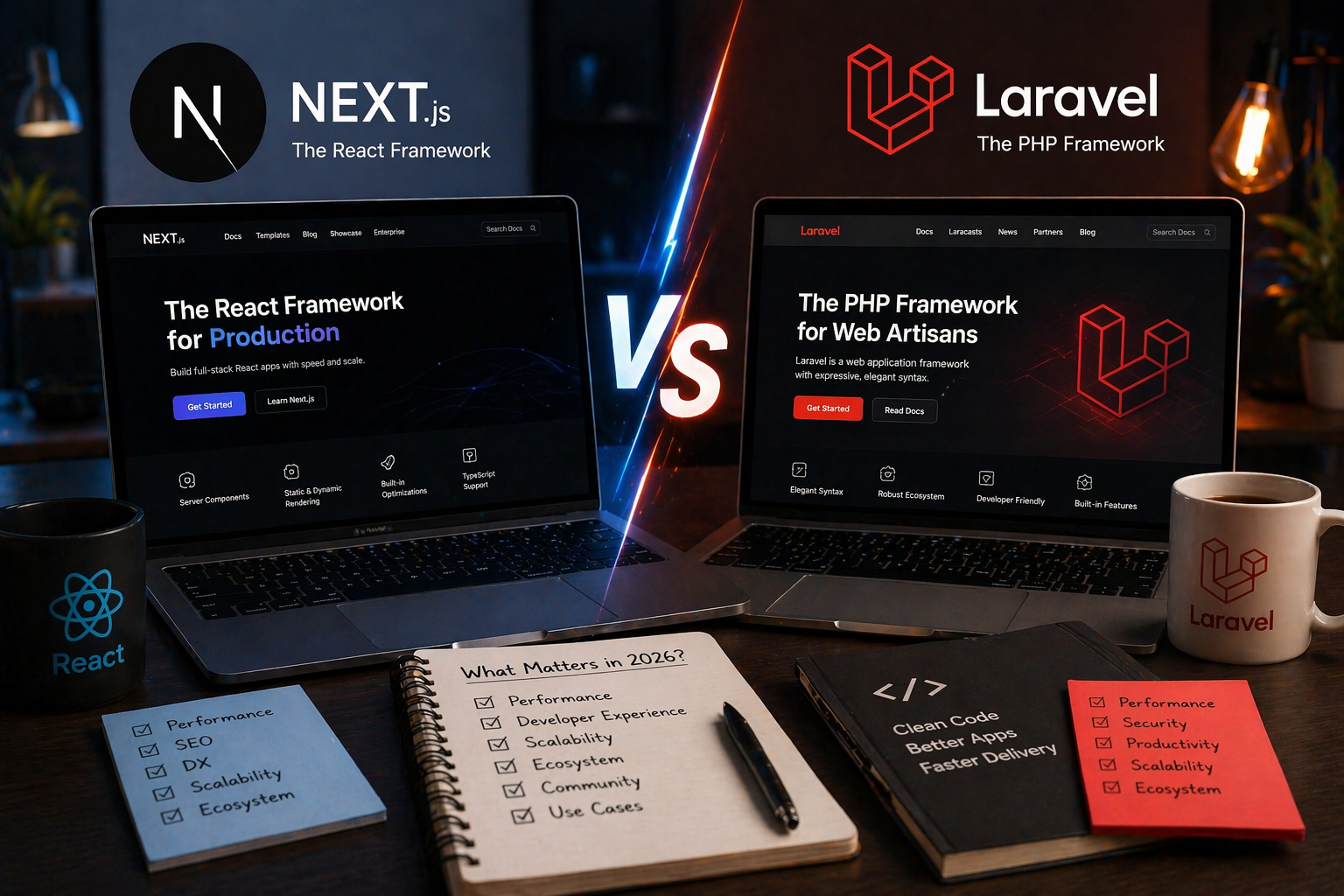
Next.js and Laravel are not direct competitors. Next.js is a React-based frontend framework with server-side rendering capabilities. Laravel is a PHP backend framework with a full MVC architecture, ORM, and routing system. Asking “which is better” is a bit like asking whether you should use a hammer or a screwdriver — the right answer depends entirely on what you’re building.
That said, there are real architectural decisions that need to be made when starting a new web application project in 2026, and understanding how these two frameworks compare helps make those decisions clearly.
“For most of our web application projects, we use both — Next.js for the frontend and Laravel as the API backend. They complement each other very well.”
— Fulgid Engineering Team
For most web application projects, we use Next.js for the frontend and Laravel as the API backend. The combination gives us the best of both: Next.js’s rendering performance and developer experience on the frontend, Laravel’s robust ORM, authentication system, and queue management on the backend. For pure API backends or projects with complex multi-tenant logic, we default to Laravel. For lightweight, content-heavy sites where a separate backend isn’t needed, Next.js with its API routes handles the backend adequately.