The Problem RAG Solves
Large language models like GPT-4 and Claude are extraordinarily capable — but they have a fundamental limitation: their knowledge is frozen at a training cutoff date and contains nothing about your specific product, your internal documentation, your customers, or your business data. Ask GPT-4 about your company’s pricing policy or your product’s feature set and it will either make something up or tell you it doesn’t know.
RAG — Retrieval-Augmented Generation — solves this by giving the model access to your specific data at query time, without requiring you to retrain or fine-tune the entire model.
How RAG Actually Works — Simply Explained
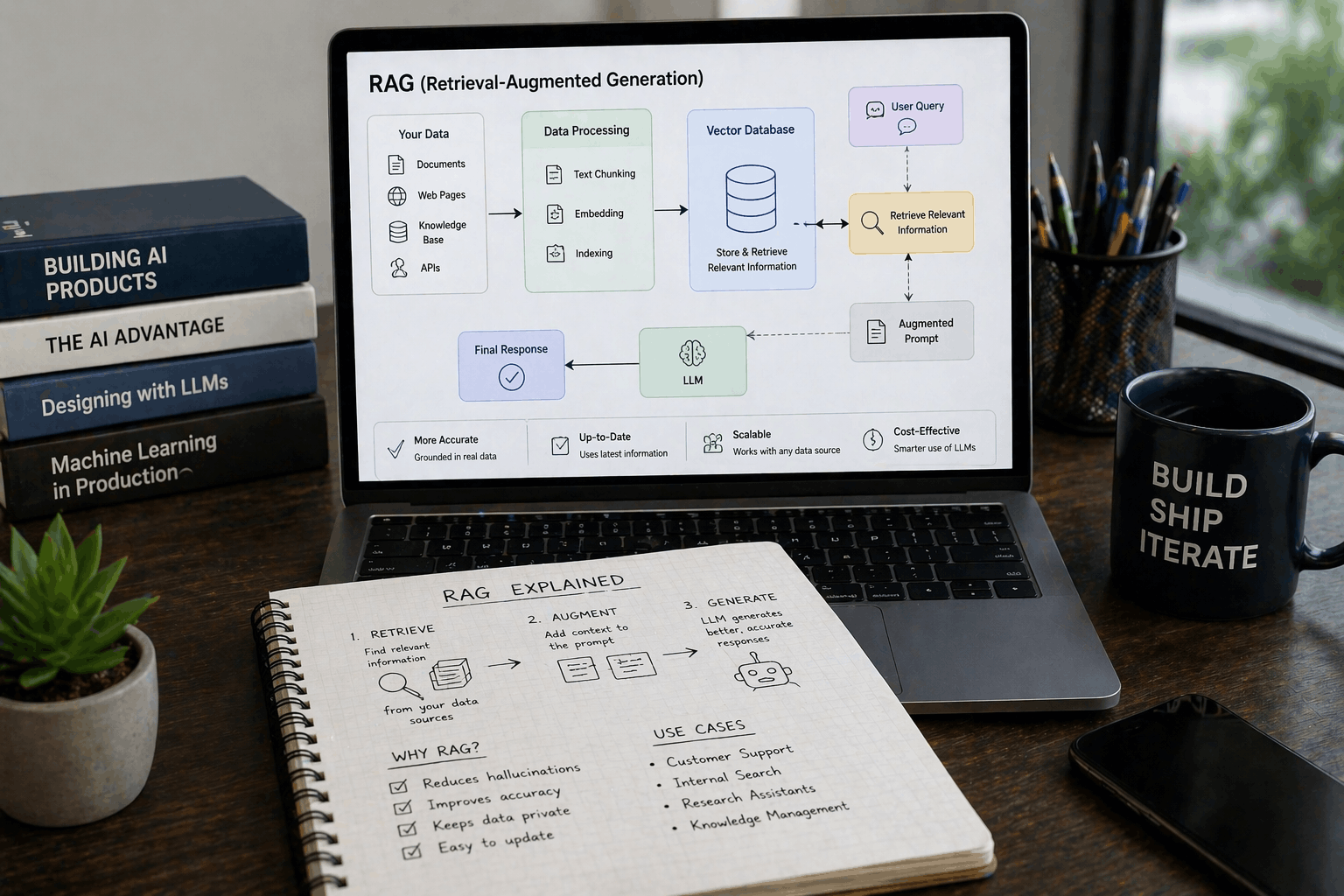
When a user asks a question, the RAG system does two things before calling the LLM. First, it converts the question into a vector (a numerical representation of meaning) and searches a vector database for the most relevant chunks of text from your data. Second, it takes those retrieved chunks and includes them in the prompt to the LLM — essentially saying “here’s the relevant context, now answer this question.”
The LLM then answers based on the actual retrieved content from your data — not from its training data. The result: accurate, specific, up-to-date answers grounded in your real information.
What Can You Use RAG For?
- “Chat with your documents”:Upload your product documentation, legal contracts, or knowledge base and let users ask questions in natural language
- Internal knowledge assistants:Let your team query internal policies, SOPs, past project notes, or customer history
- Customer support automation:An AI that answers support questions accurately using your actual product documentation — not hallucinated answers
- Code documentation search:Let developers query a large codebase or technical documentation in natural language
- Research and summarisation:Give the model access to a large corpus of documents and ask it to synthesise and summarise specific topics
RAG vs Fine-Tuning — Which Do You Need?
Fine-tuning means retraining the model on your specific data to make it behave differently — useful when you need the model to consistently respond in a particular style or domain. RAG means giving the model access to your data at inference time — useful when you need the model to answer accurately based on specific facts and documents.
For 90% of “add AI to my product” use cases, RAG is the right answer. It’s faster to build, cheaper to run, and easier to update (just update the documents in your vector database — no retraining required). Fine-tuning is the right answer when the behaviour change you need is about style and tone, not about specific factual knowledge.
What You Need to Build a RAG System
- Your data in a usable form — PDFs, markdown files, database records, web pages
- An embedding model to convert text to vectors (OpenAI, Cohere, or open-source)
- A vector database to store and search embeddings (Pinecone, pgvector, Weaviate)
- An LLM to generate the final answer (GPT-4o, Claude, Llama)
- An orchestration layer to connect them (LangChain, LlamaIndex, or custom)