Why WhatsApp Automation Has Become a Growth Lever in India
India’s startup ecosystem has a unique characteristic: customers expect WhatsApp communication. Not email. Not in-app notifications. WhatsApp. For Indian businesses, this creates both a challenge and an opportunity — the challenge of handling WhatsApp communication at scale without a team of agents, and the opportunity of reaching customers on the channel they actually check and respond to.
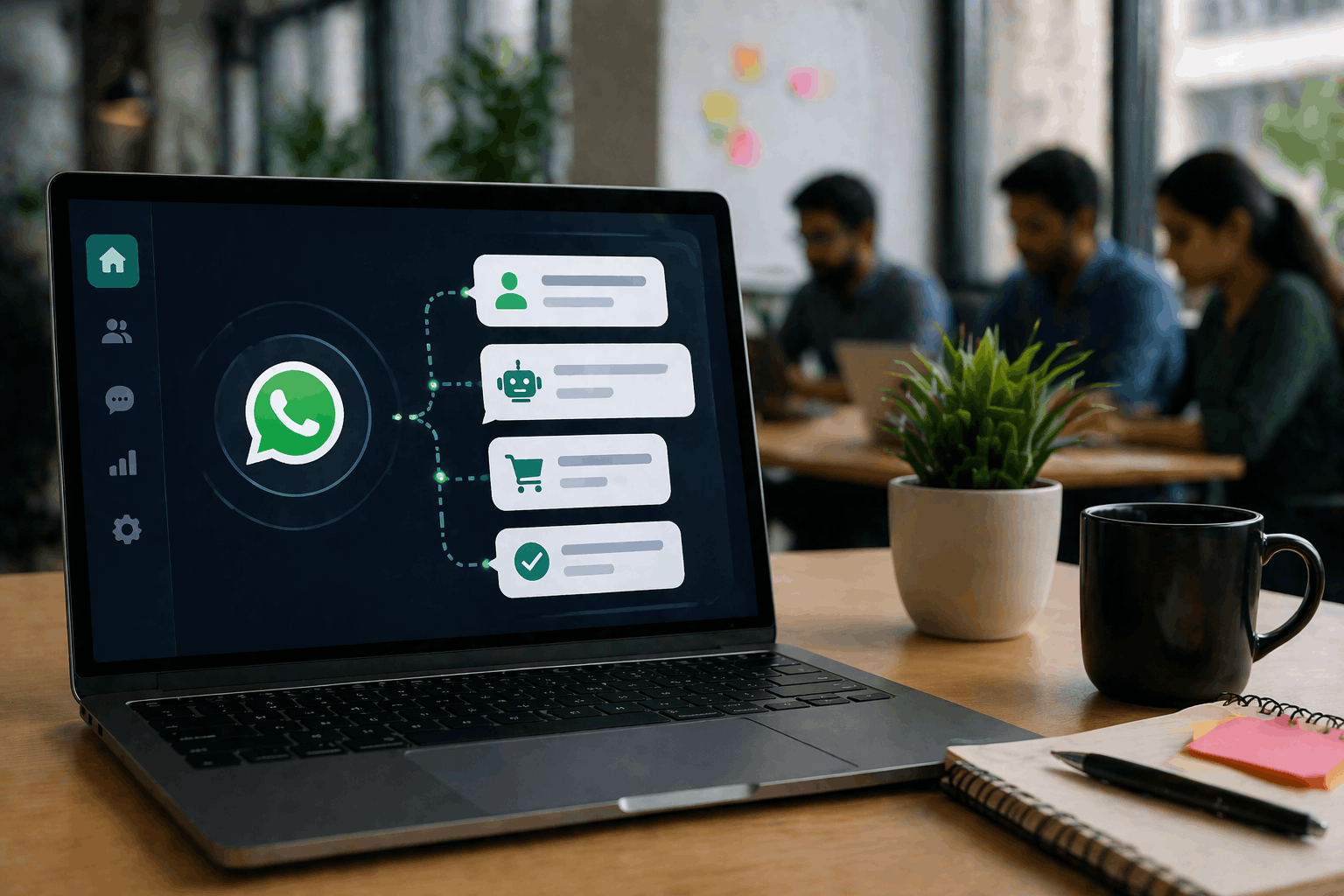
WhatsApp Business API (Meta WABA) has made it possible for startups to automate the WhatsApp communication layer — sending order confirmations, appointment reminders, payment receipts, case status updates, and lead qualification flows at any volume, 24/7, without human agents for routine interactions.
Use Case 1 — E-Commerce: Order Updates That Actually Get Read
Every Indian e-commerce business sends order confirmation emails. Most customers never open them. The same information sent via WhatsApp gets a 98% open rate. Automated WhatsApp flows for e-commerce typically cover: order confirmation, shipping dispatch with tracking link, out-for-delivery alert, and delivery confirmation. The trigger comes from the e-commerce platform (Shopify, WooCommerce) via webhook — no manual sending required.
Use Case 2 — Healthcare: Appointment Reminders That Reduce No-Shows
Healthcare clinics in India lose significant revenue to appointment no-shows. Automated WhatsApp reminders — sent 24 hours before and 2 hours before an appointment — have been shown to reduce no-shows by 30–50% for clinics that have implemented them. The system integrates with the clinic’s scheduling software, triggers automatically, and requires zero staff involvement for routine reminders.
Use Case 3 — Fintech: Payment Due Reminders and Receipts
Loan payment reminders, EMI due notifications, and payment receipts via WhatsApp have dramatically higher engagement than SMS or email equivalents. For chit fund operators, fintech lending platforms, and NBFC-adjacent businesses — automated WhatsApp payment reminders reduce collection effort and improve on-time payment rates without any human intervention.
Use Case 4 — Government & Institutional: Case Status Notifications
We’ve built WhatsApp notification systems for government healthcare platforms where donor-patient case status changes trigger immediate WhatsApp alerts to medical coordinators. The alternative — phone calls between departments — is slower, error-prone, and impossible to audit. Automated WhatsApp with delivery tracking provides a complete record of every notification sent and received.
What WhatsApp Automation Can’t Do
- Handle complex, empathy-requiring conversations — escalate to a human agent when the topic requires judgment
- Send unsolicited marketing messages to cold contacts — Meta WABA requires opt-in consent
- Replace genuine customer relationships — use automation for routine, transactional communication
Getting Started — What You Need
WhatsApp Business API requires Meta business verification (GST + business registration), a dedicated phone number, and approved message templates. The implementation complexity ranges from a few weeks for simple notification flows to a few months for complex, multi-step conversational systems. See our chatbot development page for more on what we build, or compare with our Telegram bot development service for use cases where Telegram is the better fit.