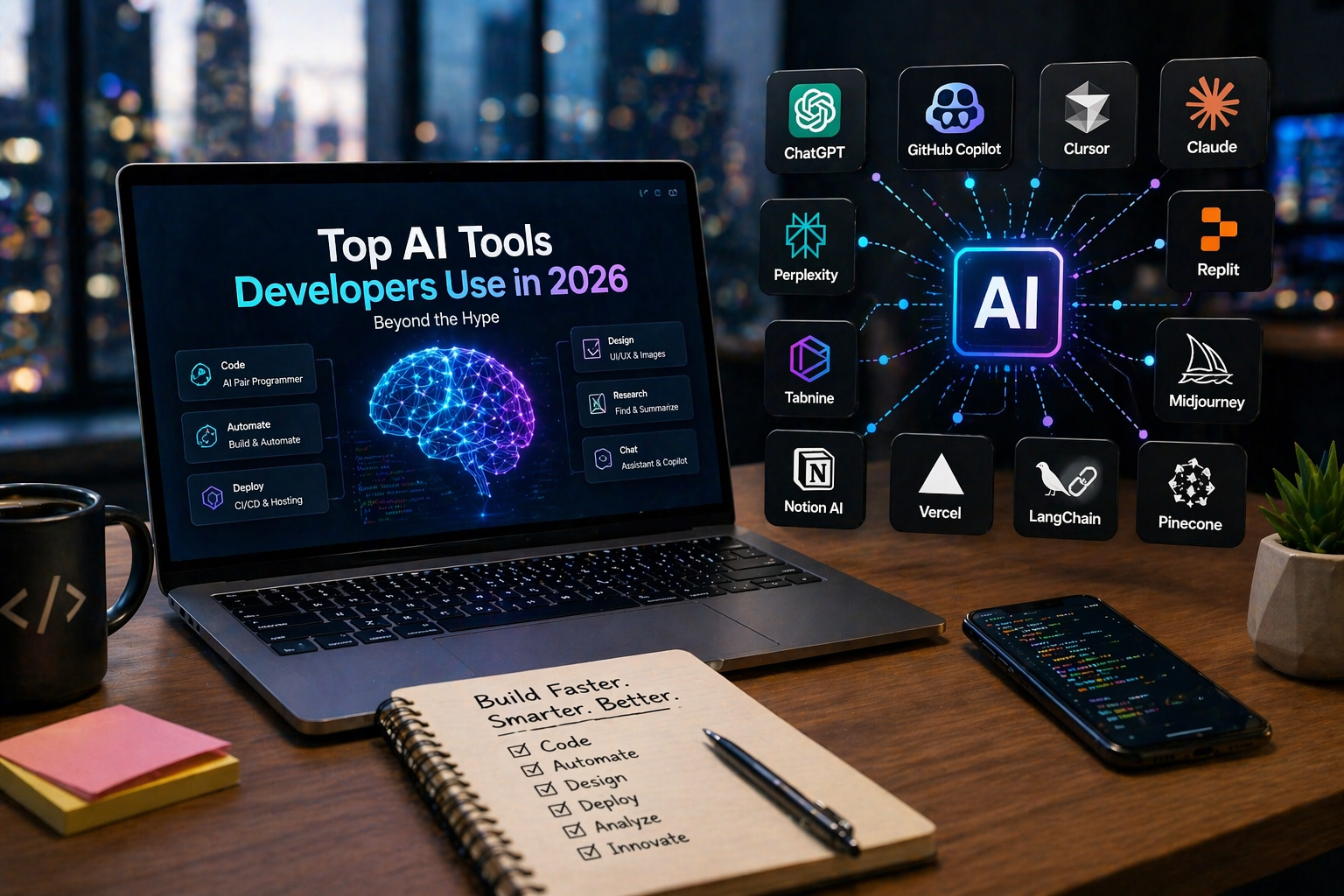
The Gap Between AI Hype and What Developers Actually Use
If you only read tech news, you’d think every developer in India is building with 15 AI tools simultaneously and shipping 10x faster than last year. The reality is more measured — there’s a core set of AI tools that genuinely change how developers work, and a much larger set that looked impressive in demos but didn’t survive contact with real projects. Here’s what Indian development teams are actually reaching for in 2026.
1. GitHub Copilot / Cursor — AI Code Completion
Code completion AI has moved from “interesting experiment” to “standard part of the workflow” for most experienced developers in India. GitHub Copilot and Cursor (which uses Claude and GPT-4 models) are the two dominant tools. Cursor in particular has gained traction because it understands the entire codebase context, not just the current file — making it genuinely useful for refactoring and working in unfamiliar codebases.
The honest assessment: these tools save real time on boilerplate, repetitive patterns, and writing tests. They don’t replace architectural thinking or problem-solving — but they’ve made the “writing the obvious code” part of development significantly faster.
2. Claude / ChatGPT — Architecture, Debugging, Documentation
Most experienced developers don’t use LLMs to write production code directly — they use them as a thinking partner. Common use cases in 2026: explaining unfamiliar codebases, generating test cases, writing documentation, debugging error messages with full stack traces, and working through architecture decisions. The key insight: these tools are most valuable when used for thinking, not just code generation.
3. LangChain / LlamaIndex — Building AI Features Into Products
For developers building AI-powered features into their products — RAG systems, AI agents, document Q&A, chatbots — LangChain and LlamaIndex have become the standard orchestration layers. They handle the plumbing of connecting LLMs to data sources, managing conversation history, and building multi-step agent workflows without having to implement everything from scratch.
4. Pinecone / pgvector — Vector Databases for AI Features
Once you’re building RAG systems or semantic search, you need a vector database. Pinecone is the managed cloud option. pgvector is the PostgreSQL extension that lets you store and query vector embeddings in your existing Postgres database — which is the more practical option for teams already running Postgres and wanting to avoid an additional managed service.
5. Whisper + ElevenLabs — Voice AI
OpenAI’s Whisper for speech-to-text and ElevenLabs for text-to-speech have opened up voice interface possibilities that were previously only available to large companies. For Indian developers, these are increasingly relevant for IVR system replacement, voice-controlled dashboards, and accessibility features in government and healthcare applications.
What’s Not Living Up to the Hype
- AI-generated entire applications:Tools that claim to generate production-ready full applications from a prompt — still not reliable enough for anything beyond throwaway prototypes
- No-code AI builders:Useful for simple automations, but break down on anything with complex business logic
- AI testing tools:Still require significant human oversight — AI-generated test cases miss context-specific edge cases that matter