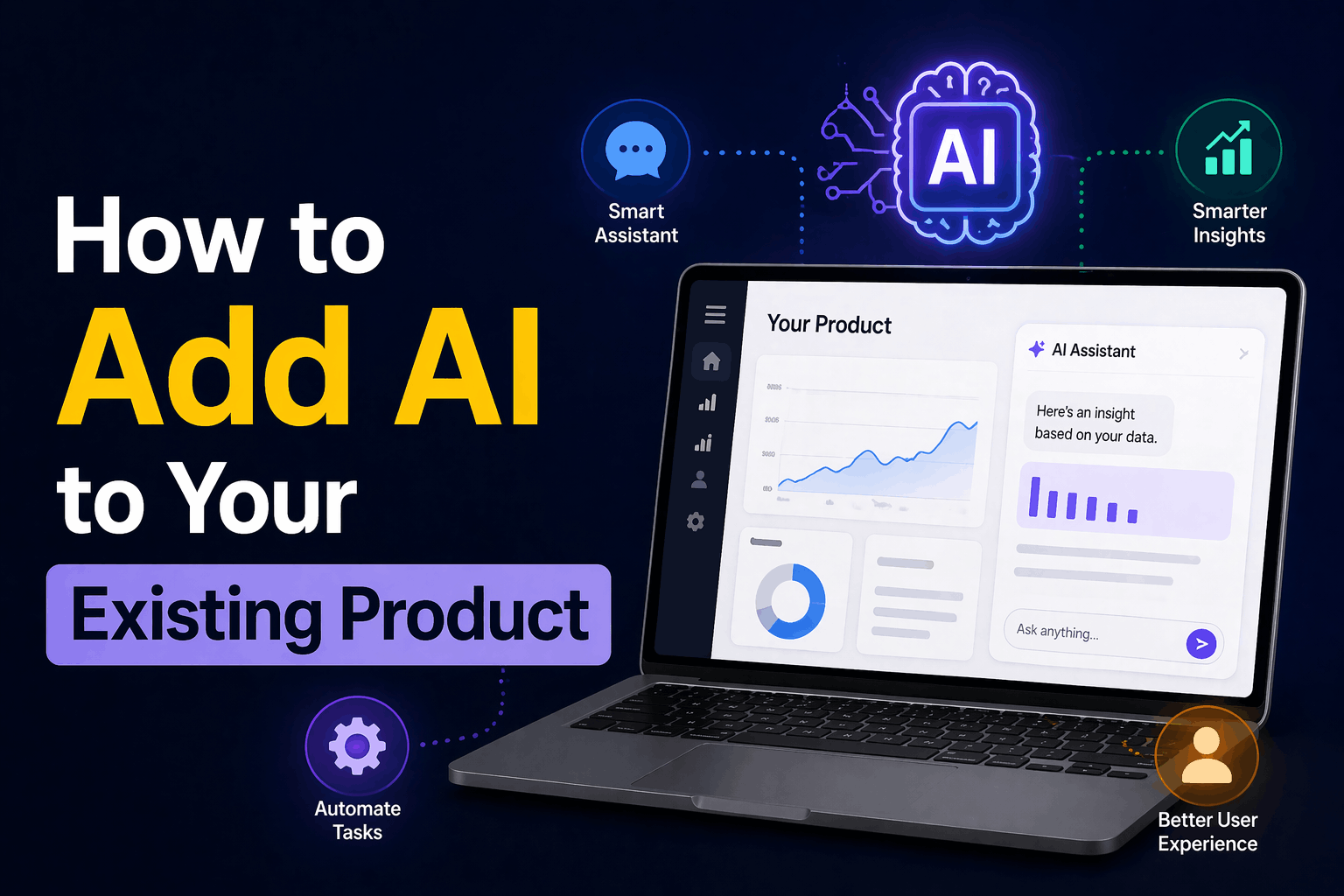
Everyone Wants AI in Their Product. Most Don’t Know Where to Start.
If you’re running a software product in 2026 and your users or investors aren’t asking about AI yet, they will be soon. But adding AI to an existing product isn’t as simple as plugging in an API key and calling it done. Done badly, it adds cost, confusion, and complexity. Done well, it can genuinely transform how your product works and what value it delivers.
This guide is for founders, product managers, and CTOs who want a practical, no-hype answer to the question: how do we actually add AI to what we’ve already built?
Step 1 — Identify Where AI Creates Real Value (Not Just Looks Good)
The first mistake most teams make is asking “where can we add AI?” instead of “what problem are we trying to solve?” AI is a tool, not a feature. The right question is: where in your product is there a task that currently requires human judgment, pattern recognition, or language understanding that could be automated or augmented?
High-value AI touchpoints to look for:
- Repetitive classification tasks — categorising tickets, tagging records, routing enquiries
- Content generation — drafts, summaries, reports your users currently write manually
- Search and retrieval — finding the right information from large internal knowledge bases
- Predictions and recommendations — “next best action”, product suggestions, anomaly detection
- Conversational interfaces — replacing forms or menus with natural language inputs
Step 2 — Choose the Right Integration Approach
Once you’ve identified the use case, the architecture question is: how do you connect AI capabilities to your existing codebase? There are three main approaches, each suited to different situations.
Direct LLM API Integration
The simplest approach — call OpenAI, Anthropic Claude, or Google Gemini’s API directly from your backend. Best for: content generation, summarisation, classification, and simple Q&A features. You control the prompts, the model, and the output format. This is where most AI integration starts.
RAG — Retrieval-Augmented Generation
When your AI needs to answer questions about your specific data — your product docs, customer records, legal documents — you need RAG. The system retrieves relevant chunks from your data (stored in a vector database like Pinecone or pgvector) and feeds them to the LLM as context. This is how you build a “chat with your data” feature without fine-tuning a model.
AI Agents and Workflows
For more complex automation — where AI needs to take multi-step actions, call other APIs, or make decisions across a workflow — you’re in agent territory. Tools like LangChain help orchestrate these flows. This is the most powerful approach but also the most complex to build reliably.
Step 3 — What Your Existing Stack Needs to Support
AI integration doesn’t happen in a vacuum — it plugs into your existing backend, database, and frontend. Before you start, your team needs to think through:
- API rate limits and cost management — LLM calls aren’t free, you need usage monitoring
- Latency — LLM responses can take 2–10 seconds, your UX needs to handle this gracefully
- Data privacy — are you sending sensitive user data to a third-party model? Do you need an on-premise or private deployment?
- Output reliability — LLMs hallucinate. Your system needs validation layers for anything mission-critical
Do You Need to Fine-Tune a Model?
Probably not — at least not yet. Fine-tuning (training a model on your specific data) is expensive, requires significant data preparation, and is only worth doing when prompt engineering and RAG have hit their limits. For most product use cases, a well-designed RAG system with a good base model will outperform a fine-tuned model at a fraction of the cost and complexity
How Fulgid Approaches AI Integration
At Fulgid, we’ve integrated AI into fintech platforms, SaaS products, and enterprise applications — always starting from the business problem, not the technology. Our process: identify the highest-value use case, evaluate the right model and architecture, build a focused integration with proper monitoring, and measure the actual impact before expanding.
We’re model-agnostic — we work with OpenAI, Anthropic Claude, Gemini, and open-source models like Llama and Mistral. The right model depends on your use case, latency requirements, data sensitivity, and budget.
If you’re thinking about AI for your product, start with a 30-minute call with our engineering team. We’ll tell you honestly whether AI is the right answer, what approach fits your stack, and what it would take to build it properly.