Trading Software in India Is a Different Beast
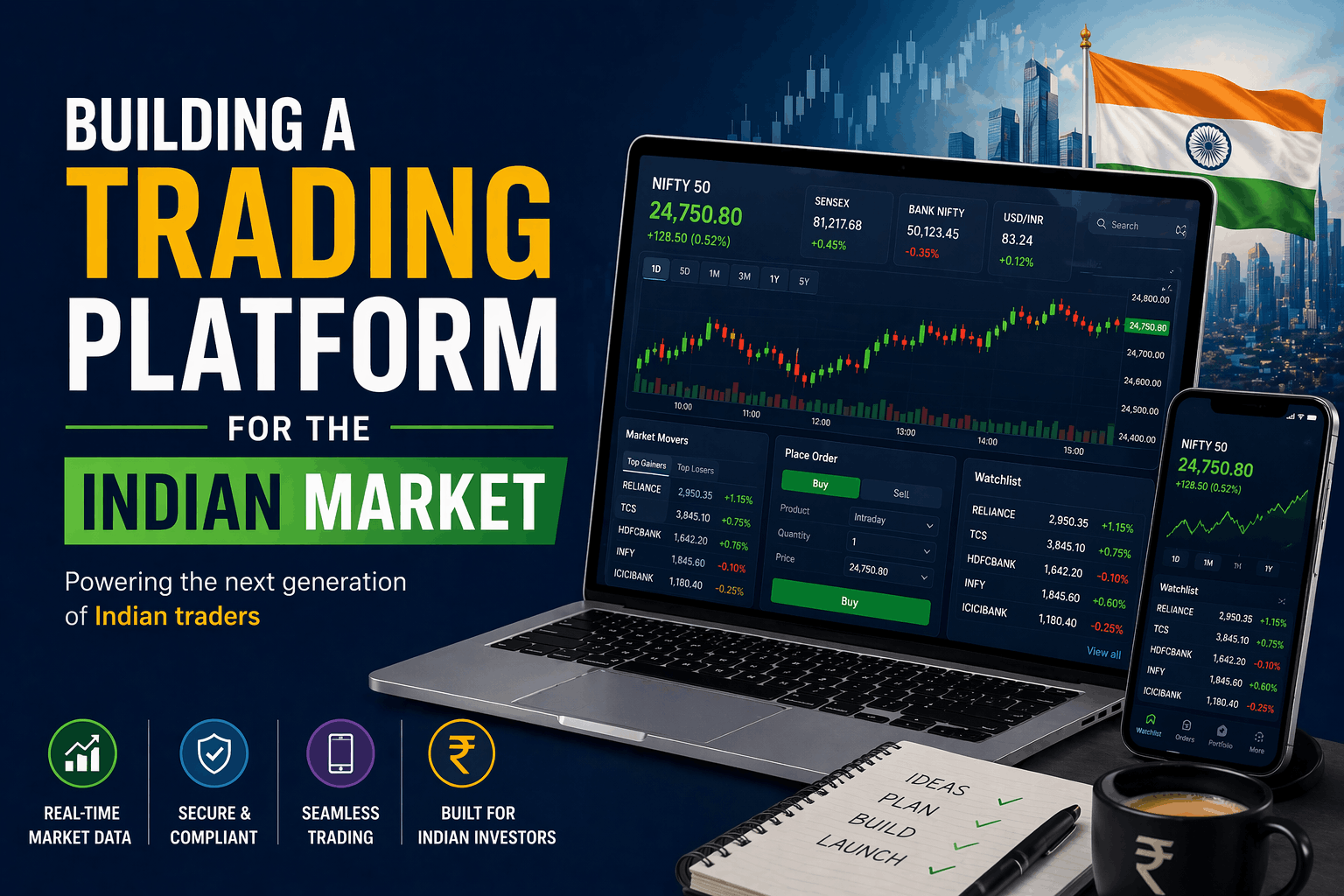
Building a trading platform for the Indian market is fundamentally different from building a generic fintech app. NSE and BSE have specific data structures, broker APIs have their own quirks, and segments like BFO and MCX come with data provider gaps that require custom computation on the backend. If you’ve tried to hire a generic development team for a trading platform, you’ve probably already discovered this the hard way.
This guide breaks down what’s actually involved in building a serious trading platform for Indian equity and derivatives markets — from data architecture to order routing.
The Data Layer: Where Most Trading Platforms Start Getting Complicated
Real-time market data in India comes primarily through data vendors like Global Datafeeds, True Data, or direct NSE/BSE feeds. For F&O options chain data, Global Datafeeds is the standard — it provides live options chain data including Greeks (Delta, Gamma, Theta, Vega) for NSE F&O instruments.
The Greeks Gap for BFO and MCX
Here’s where it gets interesting. Data vendors supply Greeks for NSE F&O — but not for Bombay Stock Exchange F&O (BFO) or MCX commodity derivatives. If your platform needs to show Greeks for these segments, you need to compute them yourself on the backend using mathematical models.
The two standard models are Black-Scholes (for most equity options) and SABR (for instruments with significant volatility skew, common in commodities). Building and maintaining these computation engines correctly — with the right underlying price, interest rate, and time-to-expiry inputs — is a significant engineering task that most generic dev teams have never done.
Broker API Integration
For order routing, the two most widely used broker APIs in India are Zerodha’s Kite API and Dhan’s API. Both provide real-time position data, order placement, and historical data — but they have different authentication flows, rate limits, and WebSocket implementations. A robust trading platform typically integrates both and allows users to connect their preferred broker account.
Signal Generation: From Data to Actionable Alerts
Once you have clean real-time data, the next layer is signal generation — identifying trading opportunities based on your strategy logic and alerting traders in real time. The most effective delivery channel for trading alerts in India is Telegram — traders use it heavily, it’s instant, and the Telegram Bot API makes it straightforward to push formatted alerts with options data.
Signal generation can range from simple rule-based alerts (e.g., “alert when IV crosses X”) to complex AI-driven pattern recognition. The architecture depends entirely on your strategy — but the infrastructure requirement is the same: low-latency event processing and reliable delivery.
Performance Requirements You Can’t Ignore
- WebSocket connections for live data must be stable across the full trading session — 9:15 AM to 3:30 PM NST, six hours of continuous data
- Greeks computation must be fast enough to update in near real-time as underlying prices move
- Order routing must handle rejection, timeout, and retry scenarios gracefully
- The system must recover cleanly from data feed interruptions without corrupting displayed state
What Fulgid Brings to Fintech Development
We’re actively building SMD — a real-time F&O trading platform for SMD Entrepreneurs — which means we’re solving these exact problems right now, not in theory. We’ve implemented the Black-Scholes and SABR models for BFO and MCX Greeks, integrated Global Datafeeds with Zerodha and Dhan APIs, and built signal generation with Telegram delivery. If you’re building in this space, we’re the team that understands the real complexity involved.